 How-to
7 Self-Compassion Habits That Transform Your Relationship
Last Updated: November 3, 2026
Quick Summary
To cultivate self-compassion within a relationship, treat yourself with the same kindness you would offer a close friend when you make a mistake or feel hurt. Practice self-kindness over self-judgment, remember that struggle is part of being human, and notice your feelings without drowning in them. Short exercises like the three-minute breathing space for two and the compassionate letter exchange help both partners stay calm and present.
- Self-kindness means speaking to yourself the way you would to someone you love.
- The three-minute breathing space for two slows your nervous system before a hard conversation.
- In the compassionate letter exchange, each partner writes a short letter about a recent struggle and you trade and read them aloud.
- A three-part script names the feeling, normalizes it, and asks for what you need.
- The 30-day progression adds one layer each week, starting with noticing self-judgment without fixing it.
Table of Contents
- What Self-Compassion Actually Looks Like in a Relationship
- How Self-Compassion Exercises for Couples Build Emotional Resilience
- Overcoming Intimacy Performance Anxiety Through Self-Kindness
- How to Communicate Needs in a Relationship Without Defensiveness
- The Shadow Side of Self-Compassion: When It Becomes Avoidance
- Self-Compassion During Relationship Crises and Triggering Moments
- Building a Daily Practice: Small Habits That Change Relational Dynamics
- Book a Call to Explore Somatic Coaching for Deeper Connection
- Frequently Asked Questions
What Self-Compassion Actually Looks Like in a Relationship
Self-compassion in a relationship is the practice of treating yourself with the same kindness you would offer a close friend, especially when you make a mistake or feel hurt.

It shows up in small moments. You catch yourself mid-argument and soften your inner voice. You notice shame rising and name it instead of hiding.
Many people confuse self-compassion with self-pity or letting yourself off the hook. It is neither. It is generally understood as a form of emotional resilience built one honest moment at a time.
Self-Kindness vs. Self-Judgment
Self-kindness means speaking to yourself the way you would to someone you love. Self-judgment is the harsh inner critic that says you ruined the evening, that you are too much, that you should know better by now.
In practice, the difference sounds like this:
- Self-judgment: "I always shut down. Something is wrong with me."
- Self-kindness: "I got overwhelmed. That makes sense given my history."
The second version leaves room to reconnect. The first one builds a wall.
Common Humanity and Mindfulness
Common humanity is the reminder that struggle is not a personal defect. It is part of being human. Your partner has an inner critic too.
Mindfulness means noticing what you feel without drowning in it. You observe the tightness in your chest and say, "There is fear here." You do not become the fear.
Together, these two habits pull you out of isolation and into connection.
How Self-Compassion Exercises for Couples Build Emotional Resilience
Self-compassion exercises for couples are short, repeatable practices that help both partners stay calm and present during hard moments. The goal is not perfection. It is a shared habit of returning to each other after stress.
Two exercises work especially well. Both take under fifteen minutes.
The Three-Minute Breathing Space for Two
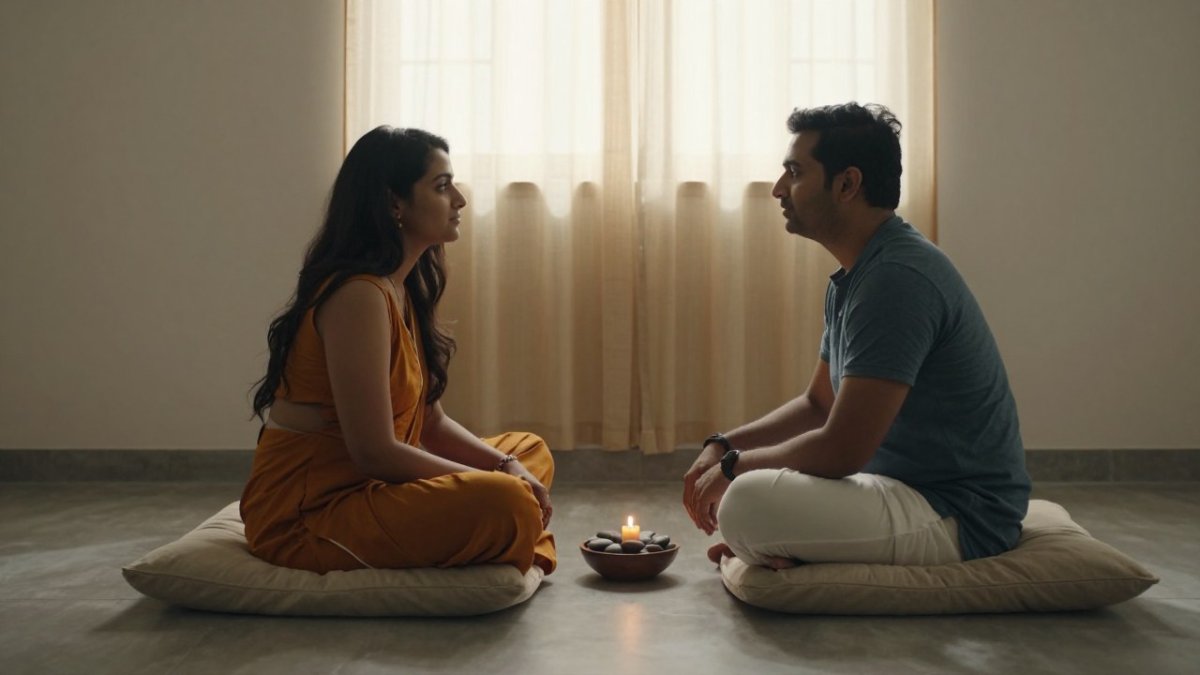
This exercise slows your nervous system before a hard conversation. Sit facing each other, feet flat on the floor.
- Minute one: notice what you feel, without judging it.
- Minute two: follow your breath, together, in silence.
- Minute three: widen your attention to the room and to your partner.
A simple pause like this may help some people feel less reactive. You can read more breathing exercises for nervous system health if you want to build on the practice.
The Compassionate Letter Exchange
Each partner writes a short letter to themselves about a recent struggle. Then you trade letters and read them aloud to each other.
The rules are simple:
- Write about a moment you felt ashamed or inadequate.
- Address yourself by name.
- End with one kind sentence.
This kind of exercise can help partners understand each other's inner experience.
Overcoming Intimacy Performance Anxiety Through Self-Kindness
Overcoming intimacy performance anxiety starts with dropping the performance. When you treat yourself kindly, the pressure to be flawless loses its grip. Anxiety feeds on self-judgment, so kindness starves it.
Many people carry a harsh inner critic into the bedroom. That critic watches every moment and keeps score. Self-kindness interrupts the loop by changing what you pay attention to and how you interpret what you notice.
The Self-Judgment Loop That Fuels Performance Anxiety
Performance anxiety rarely begins in the bedroom. It usually starts with a thought like "I should be better at this" or "If I lose focus, they will be disappointed." That thought triggers a stress response: heart rate rises, attention narrows, and your body feels less like yours.
Self-kindness breaks the loop at the interpretation step. Instead of reading a racing heart as proof of failure, you read it as arousal or excitement. Instead of reading a wandering mind as evidence that something is wrong, you read it as a normal attention shift.
Somatic Awareness: Feeling Your Body Without Judgment
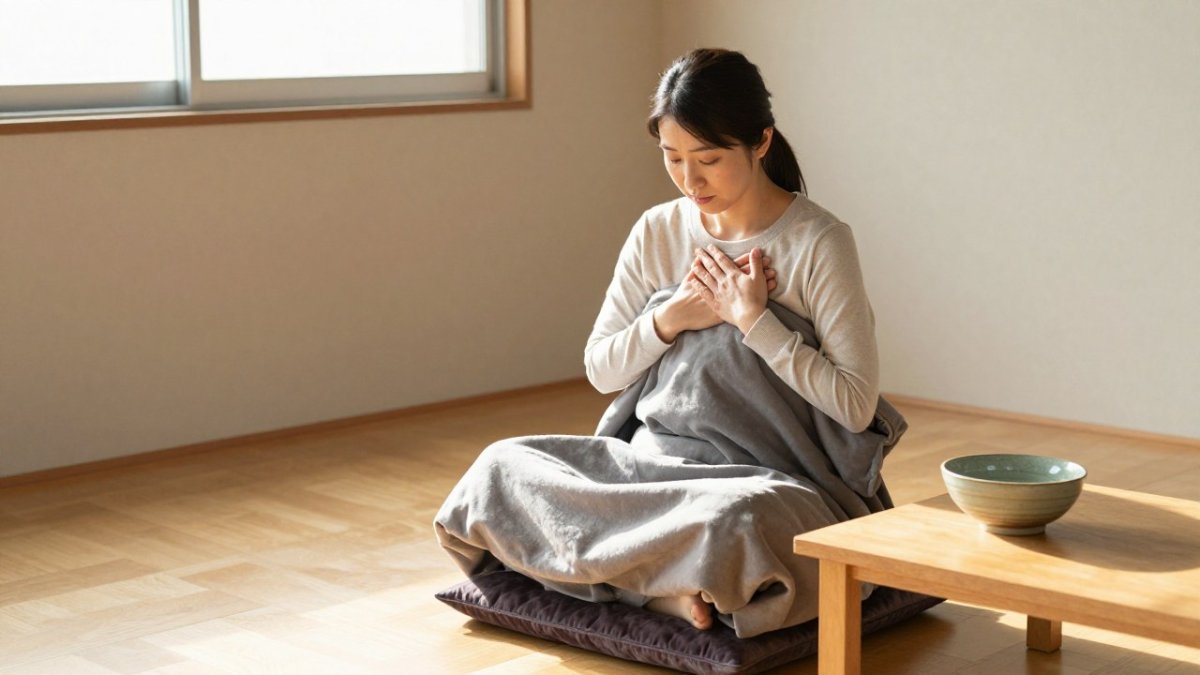
Somatic awareness means noticing physical sensation without labeling it good or bad. You feel warmth, tension, or numbness. You simply observe.
Try this:
- Pause and name three physical sensations.
- Breathe into the tightest spot.
- Let your partner know what you notice.
This body-based approach sits at the heart of our somatic intimacy coaching work. It helps you stay in your body instead of retreating into your head.
Watch out: somatic awareness can become another performance metric if you start grading yourself on how well you notice sensations. The goal is curiosity, not a new scorecard.
A Script for Naming Anxiety Without Shame
Self-kindness is easier to practice when you have language ready. Try this three-part script before or during an intimate moment:
- Name the feeling: "I notice I am feeling anxious right now."
- Normalize it: "That makes sense. My body is trying to protect me."
- Ask for what you need: "Can we slow down for a minute?"
This script works because it replaces self-criticism with information. Your partner hears a need instead of a verdict, and you hear your own voice as an ally instead of a judge.
For a deeper look at this pattern, see our guide on how to overcome intimacy performance anxiety.
How to Communicate Needs in a Relationship Without Defensiveness
Defensiveness is the instinct to protect yourself when you feel accused. It shuts down connection fast. The antidote is a mix of self-compassion and clear, honest language.
Try this structure when you raise something hard:
- Start with what you feel, not what they did.
- Ask for one specific thing.
- Make room for their side.
For example: "I felt lonely last night. I would like a few minutes of quiet time together. How does that sound to you?"
When shame is under the surface, naming it helps. Our guide on how to talk to your partner about shame walks through that conversation step by step.
The Shadow Side of Self-Compassion: When It Becomes Avoidance
Self-compassion can quietly turn into avoidance. When "being kind to yourself" becomes a reason to dodge hard conversations, it stops being compassion and starts being escape.
Watch for these signs:
- You soothe yourself but never address the problem.
- You use rest as a way to avoid conflict.
- You tell yourself "I deserve peace" while the issue grows.
Real self-compassion includes accountability. It says, "I was unkind, and I want to repair that." Kindness without honesty is just avoidance wearing a calm face.
Self-Compassion During Relationship Crises and Triggering Moments
Crises test the habit you have built. A fight, a betrayal, or a triggering moment can send your nervous system into overdrive. Self-compassion is what helps you come back.
In those moments, try this:
- Pause before you react.
- Name the feeling out loud.
- Remind yourself that this wave will pass.
Triggers often point to old wounds, not the current moment. Understanding nervous system dysregulation in relationships can help you spot the pattern. Self-compassion lets you respond to the wound instead of attacking your partner.
Building a Daily Practice: Small Habits That Change Relational Dynamics
A daily practice does not need to be long. Small, repeated habits reshape how you relate to yourself and your partner over time. Self-compassion is commonly described as a skill that can strengthen with repetition.
A structured 30-day progression can help build tolerance for self-kindness without turning it into another task to fail at.
Why Small Habits Beat Grand Gestures
Grand gestures are hard to repeat, and they raise the stakes. Small habits are easy to repeat, and repetition is what builds the neural pathways that make self-compassion feel natural. Short daily check-ins are often easier to sustain than occasional longer sessions, and regular repetition can help the nervous system become more accustomed to kindness.
A common pattern is that people start with too much and quit within a week. The fix is to set the bar low enough that you cannot fail.
The 30-Day Self-Compassion Progression
This progression is designed to be done alongside your partner, but it works solo as well. Each week adds one layer.
Week 1: Notice without fixing. Once a day, name one moment of self-judgment out loud or in writing.
Week 3: Share one observation with your partner. Once a day, tell your partner one thing you noticed about your inner critic.
Watch out: the 30-day frame can become a perfectionism trap.
A Simple Daily Habit Table
| Habit | Time | When to Do It |
|---|---|---|
| Morning self-check-in | 2 minutes | Before you leave bed |
| Pause before reacting | 10 seconds | Any tense moment |
| Evening appreciation | 3 minutes | Before sleep |
| Weekly letter exchange | 15 minutes | Once a week |
Start with one habit. Add the next when it feels natural. Consistency matters more than intensity.
Tracking Without Judgment
Tracking can help, but only if the tracking itself is compassionate. Use a simple note on your phone with three columns: what happened, what you noticed, and what you did next. Review it once a week with curiosity, not grading. If you miss a day, write down why without criticism. The data is there to show patterns, not to build a case against you.
Book a Call to Explore Somatic Coaching for Deeper Connection
Self-compassion is a skill, and like any skill, it can be easier to develop with guidance. If you want to explore moving beyond performance toward embodied connection, you can reach out to learn more.
At The BodyVox, our work is trauma-informed and client-led. We offer Private 1:1 Immersions for Individuals and Couples, and for those interested in power and surrender, our BDSM/Authority Transfer/Embodied Power Training explores these themes through consent and self-awareness.
Not sure if it is the right fit? Read about the signs you need somatic intimacy coaching before you reach out.
Frequently Asked Questions
How does self-compassion impact romantic relationship satisfaction?
Some research in positive psychology has explored links between self-compassion and relationship satisfaction. Treating yourself kindly during conflict may make it easier to avoid lashing out or shutting down, which can create a sense of psychological safety for your partner. Practicing self-kindness and mindfulness daily, even for a few minutes, may gradually support relational dynamics and emotional resilience.
Can self-compassion exercises for couples reduce performance anxiety in intimate moments?
Self-compassion exercises for couples, such as the three-minute breathing space or compassionate letter exchange, may help some people feel calmer. Judging yourself less during intimacy may ease performance pressure for some people. Somatic awareness practices may also help you stay present in your body. With regular practice, these exercises may support emotional availability and reduced shame for some couples.
What is the difference between self-compassion and self-esteem in relationships?
Self-esteem often depends on feeling special or above average, which can lead to comparison and defensiveness when your partner succeeds. Self-compassion, by contrast, is about treating yourself with kindness regardless of outcomes. In relationships, self-compassion fosters common humanity (recognizing that imperfection is normal) and reduces the need to prove yourself. This creates more space for empathy and interdependence, while self-esteem can sometimes create distance or competition.
How can I stop being so self-critical during intimate moments?
Start by noticing the inner critic without judgment. Try a brief mindfulness pause: take three slow breaths and silently say, 'This is a moment of struggle. May I be kind to myself.' Shift attention to physical sensations, like the temperature of your partner's skin or the rhythm of your breath, rather than evaluating your performance. Practicing self-compassion exercises for couples outside the bedroom, such as the compassionate letter exchange, can also train your mind to respond with kindness instead of criticism.
Building self-compassion inside a relationship takes patience, honesty, and a willingness to be kind to yourself when it is hardest. That is the work we do at The BodyVox. Our somatic, body-based approach helps you reclaim body awareness, navigate intimacy beyond shame or performance, and build skills for lasting connection. Get started with The BodyVox and take the first step toward deeper, more embodied intimacy.