 how-to
How to Overcome Intimacy Performance Anxiety
Table of Contents
- What Intimacy Performance Anxiety Actually Is
- Common Causes of Intimacy Performance Anxiety
- Nervous System Regulation for Intimacy: Calming the Body First
- Mindfulness Techniques for Sexual Intimacy
- How to Talk to Your Partner About Performance Anxiety
- Redefining Intimacy Beyond Performance Goals
- When to Seek Professional Support: Somatic Coaching and Therapy
- Conclusion
Last Updated: August 28, 2026
What Intimacy Performance Anxiety Actually Is
Intimacy performance anxiety is a pattern of fear, self-monitoring, and physical tension that disrupts natural arousal and presence during sexual activity. It's not a character flaw, it's your nervous system protecting you from perceived threat, even when the threat isn't real.
At The BodyVox, we work with this pattern regularly across all genders, orientations, and relationship structures. The common thread isn't weakness. It's a nervous system that learned to brace. Intimacy performance anxiety is one of the most common contributors to sexual dysfunction, including erectile dysfunction, difficulty with arousal, and low libido.
The Physiological Feedback Loop That Keeps It Going
Anxiety about performance triggers your sympathetic nervous system, redirecting blood away from the genitals toward major muscle groups. Arousal becomes physiologically harder to access. You notice this happening, which increases self-consciousness, which deepens the anxiety, which further suppresses arousal.
This loop is self-reinforcing. The more you monitor your body for signs of failure, the more you activate the very system that prevents the response you're looking for. According to research on the autonomic nervous system and sexual response, the parasympathetic nervous system, not the sympathetic, governs arousal and sexual function. You cannot perform your way out of this. You have to calm your way in.
Common Causes of Intimacy Performance Anxiety
Past sexual experiences that felt humiliating or unsuccessful create anticipatory dread. The body remembers, and the nervous system pattern fires even when the current partner is safe.
Cultural and internalized messaging about what sex is supposed to look like creates performance standards most real human bodies can't consistently meet. For LGBTQ men especially, this often intersects with shame about desire itself.
Relationship dynamics play a significant role. Unspoken tension, fear of disappointing a partner, or emotional unavailability can make the body contract rather than open.
Physical health factors like fatigue, hormonal changes, medication side effects, and age-related shifts in sexual response can compound psychological ones. The anxiety cycle typically starts with one difficult experience and becomes a pattern through anticipation.
Nervous System Regulation for Intimacy: Calming the Body First
The body isn't a problem to overcome. It's the doorway back in. Before any conversation or technique can take hold, the nervous system needs to feel safe enough to shift out of a defensive state.
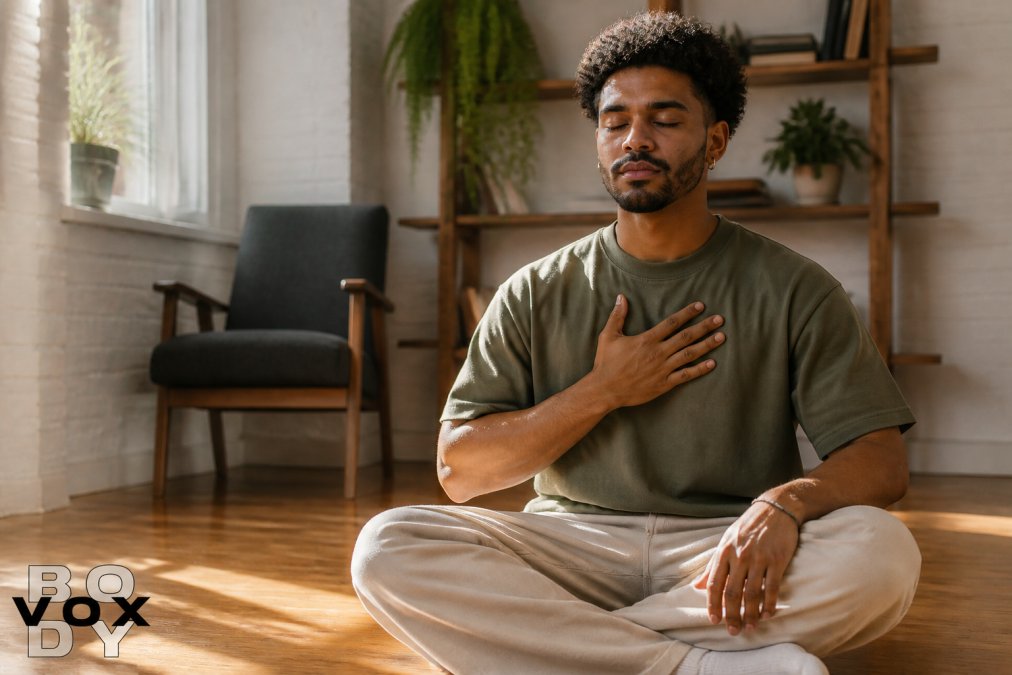
Step 1: Diaphragmatic Breathing Before and During Sex
Diaphragmatic breathing directly activates the parasympathetic nervous system. Practice this before intimacy:
- Lie or sit comfortably with one hand on your chest and one on your belly
- Inhale slowly through your nose for a count of four, directing the breath into your belly
- Hold gently for two counts
- Exhale through your mouth for a count of six
- Repeat for five to ten cycles
The extended exhale activates the vagus nerve and downregulates the sympathetic response.
Step 2: Sensate Focus Exercises to Remove Performance Pressure
Sensate focus is a structured approach developed within sex therapy that removes performance goals entirely from intimate touch. It's one of the most evidence-supported tools for addressing sexual performance anxiety.
The core structure:
- Phase 1: Non-genital touch only. Partners explore each other's bodies with curiosity, not goal. No arousal is expected.
- Phase 2: Gradually include genital areas, still without pressure toward arousal or orgasm
- Phase 3: Introduce mutual touch, still with no performance expectation
When there's no "goal" to fail at, the nervous system stops bracing. Arousal, when it comes, arrives as a natural byproduct of presence.
Step 3: Grounding Practices to Reconnect With Your Body
Grounding practices bring attention back into the body and out of the evaluative mind. Before intimacy, stand barefoot and press your feet firmly into the floor. Feel the texture beneath you. Slowly roll your weight from heel to toe. Place both hands flat on your thighs and notice the warmth. Take three slow breaths with your eyes open. This takes sixty seconds and shifts your attention from mental commentary to physical sensation.
Mindfulness Techniques for Sexual Intimacy
Sexual mindfulness specifically targets the self-monitoring and self-consciousness that fuel intimacy performance anxiety. The core shift is from evaluation to observation.
Most people experiencing performance pressure run an internal commentary: Is this working? What does my partner think? Why isn't my body responding? Mindfulness teaches you to notice this commentary without treating it as truth.
Choose one sensory channel and stay with it: the warmth of skin contact, the sound of breathing, or the specific pressure of touch. When the evaluative mind pulls you out, return to the sensation without judgment. According to mindfulness-based interventions for sexual dysfunction research, mindfulness-based approaches show meaningful improvements in sexual arousal, desire, and satisfaction. Presence and performance anxiety cannot fully occupy the same nervous system at the same time.
Before an intimate encounter, spend a few minutes recalling a past moment of genuine connection or pleasure, a real memory of feeling present in your body, not a fantasy of perfection. This primes the nervous system toward openness rather than vigilance.
How to Talk to Your Partner About Performance Anxiety
Silence about intimacy performance anxiety almost always makes it worse. The partner who doesn't know what's happening often fills the gap with their own story: They're not attracted to me. I did something wrong. That story creates tension, which deepens the cycle.

The conversation works best outside of any intimate context. A useful frame: "I want to share something with you because I think it'll help us both. I've been experiencing some anxiety around sex that has nothing to do with how I feel about you. I want to work through it and I'd like your help understanding what makes it easier."
A Partner-Specific Guide: What Helps and What Hurts
What helps:
- Expressing desire without expectation. "I love being close to you" opens space; "I want to have sex tonight" creates performance context.
- Slowing down without drawing attention to it. A partner who naturally extends foreplay and sensual touch creates safety without spotlighting the problem.
- Affirming non-performance moments. Physical closeness that doesn't lead to sex should be treated as complete in itself.
- Asking rather than assuming. "What feels good right now?" keeps both people present.
What hurts:
- Checking in too frequently during sex in a way that signals monitoring
- Expressing frustration or disappointment, even subtly
- Treating every intimate encounter as a test of whether the anxiety is "fixed"
- Withdrawing physically after a difficult experience
Redefining Intimacy Beyond Performance Goals
The deepest shift available isn't a technique. It's a reframe of what intimacy is for.
Performance-oriented intimacy treats sex as something that either succeeds or fails based on measurable outcomes: arousal, duration, orgasm. This framework is almost perfectly designed to produce anxiety.
Embodied intimacy treats sexual and physical closeness as a space for presence, sensation, and emotional connection. Arousal becomes something that may or may not arise, rather than something that must be produced. Pleasure is defined by the quality of attention rather than the achievement of specific outcomes.
Most people, when they reflect on their best sexual memories, describe presence and connection, not technical performance.
| Intimacy Goal | Performance Framing | Embodied Framing |
|---|---|---|
| Arousal | Must be achieved | May arise naturally |
| Orgasm | Required for success | One possible experience |
| Duration | Longer is better | Present is enough |
| Foreplay | Means to an end | Valuable in itself |
| Difficulty | Failure | Information |
| Partner response | Validation needed | Connection, not evaluation |
When to Seek Professional Support: Somatic Coaching and Therapy
Many people spend years in talk therapy without meaningful change in their experience of intimacy. Intimacy performance anxiety lives in the body, in the nervous system's conditioned responses. Talking about it builds understanding but rarely changes the somatic pattern on its own.
Somatic sex and intimacy coaching works directly with the body's responses. Sessions are client-led, consent-centered, and designed to build nervous system capacity rather than manage symptoms. According to American Association of Sexuality Educators, Counselors and Therapists resources on somatic approaches, body-based approaches to sexual concerns are gaining recognition as an important complement to traditional psychotherapy.
Cognitive behavioral techniques and couples therapy remain valuable, especially when relationship dynamics, communication patterns, or depression are significant factors. The most effective support often combines modalities.
At The BodyVox, Court Vox offers specialized somatic sex and intimacy coaching, surrogate partner therapy, and couples coaching through a trauma-informed, client-led approach. Affiliated with IPSA, SSEA, and Back to the Body, and featured in publications including Vogue, Men's Health, and the Los Angeles Times, the work is grounded in professional training and clinical depth. Private 1:1 Immersions for Individuals and Couples and Somatic Sensual Retreats for GBTQ Men are available for those ready to move beyond performance toward embodied connection.
Post-Anxiety Recovery: What Progress Actually Looks Like
Progress in overcoming intimacy performance anxiety rarely looks like a clean upward line. You have a genuinely present experience, then anxiety shows up again two weeks later. Most people interpret this as relapse. It isn't. It's the normal, nonlinear pattern of nervous system change.
What actually shifts over time:
- Recovery speed. The anxiety arrives, but you return to presence faster
- Intensity. The physiological activation is less overwhelming
- Interpretation. You stop treating anxiety as permanent failure and start reading it as information
- Partner communication. Difficult moments become navigable rather than relationship-threatening
- Baseline. The proportion of intimate experiences that feel genuinely good increases
The goal isn't permanent elimination of vulnerability. It's developing enough somatic skill and relational safety that vulnerability doesn't collapse into shutdown.
Intimacy performance anxiety is one of the most treatable challenges in sexual health, and one of the most underaddressed. The coping strategies exist. The professional support exists. The path from performance pressure to genuine, embodied connection is real and well-traveled.
The BodyVox offers private 1:1 immersions and somatic retreats for individuals and couples ready to work with the body, not against it. Book A Call to explore what a client-led, trauma-informed approach could look like for your specific situation.
Frequently Asked Questions
Why do I feel so anxious during intimacy?
Anxiety during sex often stems from the sympathetic nervous system activating a stress response at the worst possible moment. Self-consciousness, past negative experiences, body image concerns, or fear of disappointing a partner can all trigger this response. The body reads anticipated judgment as a threat, flooding the system with stress hormones that directly interfere with arousal. Understanding this cycle is the first step, intimacy performance anxiety is a physiological pattern, not a personal failing, and it responds well to body-based coping strategies.
Can somatic practices help with sexual performance anxiety?
Yes. Somatic practices address intimacy performance anxiety at the level of the nervous system rather than through thought alone. Techniques like sensate focus, conscious breathing, and grounding exercises teach the body to stay regulated during moments of vulnerability. Unlike traditional talk therapy, somatic work builds embodied awareness over time, helping you recognize and shift arousal-blocking tension before it takes hold. For many people, especially those who have not found relief through cognitive approaches, body-based learning produces more lasting change.
How do I help a partner who is experiencing performance anxiety?
Remove outcome pressure first. Avoid reassurance that still centers performance, such as telling them to just relax. Instead, openly shift the goal of the encounter away from any specific act. Explore sensual touch, massage, or closeness without expectation. Ask what feels good rather than what they want to do. Couples therapy or somatic intimacy coaching can also give both partners structured tools and a safe space to address the anxiety cycle together, which tends to be more effective than navigating it alone.
What is the role of communication in overcoming intimacy anxiety?
Open communication reduces the silent pressure that feeds the anxiety cycle. When partners can name what they are feeling without shame, intimacy goals shift from performance to connection. Talking before, not only during, a sexual encounter allows both people to set a shared tone. Specific conversations about boundaries, preferences, and what safety feels like in the body build the emotional foundation that makes physical vulnerability possible. Many people find that honest dialogue alone produces a noticeable drop in performance pressure.
This article was written using GrandRanker