 How-to
How to Use Guided Nervous System Regulation Sessions Online
Last Updated: November 13, 2026
Quick Summary
Guided nervous system regulation sessions online are live or recorded audio and video practices led by a trained facilitator to help you shift out of a stress response and back toward a calmer baseline. Match the practice to your current state, and start with two short sessions weekly, adding one only when the current load feels easy.
- Relaxation is a temporary state, while regulation is a skill that trains your body to return to balance over time.
- A first nervous system meditation script runs roughly ten minutes through orienting, low breathing, body check, grounding, and closing.
- The 10 minute vagus nerve meditation combines slow breathing, humming or toning, and calm attention, with slow exhales as a substitute if humming feels uncomfortable.
- Ask facilitators in writing about training, supervision, scope of practice, consent, privacy, and cancellation before you book.
- A five-minute practice done four times a week does more than a 40-minute session you dread.
Table of Contents
- What Guided Nervous System Regulation Sessions Online Actually Do
- A Repeatable Nervous System Meditation Script for Your First Session
- Somatic Exercises for Nervous System Regulation You Can Do at Home
- The 10 Minute Vagus Nerve Meditation: What It Is and When to Use It
- A Trauma-Informed Body Scan Meditation: Adapting It to Your Body
- Choosing a Session Based on Your Current State
- How to Evaluate Online Sessions and Facilitators
- Building a Practice That Fits Your Nervous System
- Frequently Asked Questions
What Guided Nervous System Regulation Sessions Online Actually Do
Guided nervous system regulation sessions online are live or recorded audio and video practices led by a trained facilitator to help you shift out of a stress response and back toward a calmer baseline. The facilitator's voice, pacing, and pauses can give your system something steady to follow when your own internal signals feel loud or numb.
National Center for Complementary and Integrative Health overview of meditation and mind-body practices
Regulation Versus Relaxation: The Difference That Matters
Relaxation is a temporary state. Regulation is a skill. A relaxation track may help you feel calmer for an hour, but regulation practice trains your body to return to balance on its own over time. That distinction changes how you choose a session. If you want a quick wind-down, almost anything gentle works. If you want lasting change in how you handle stress, you need a repeatable practice with clear steps, not just soothing music.
A Repeatable Nervous System Meditation Script for Your First Session
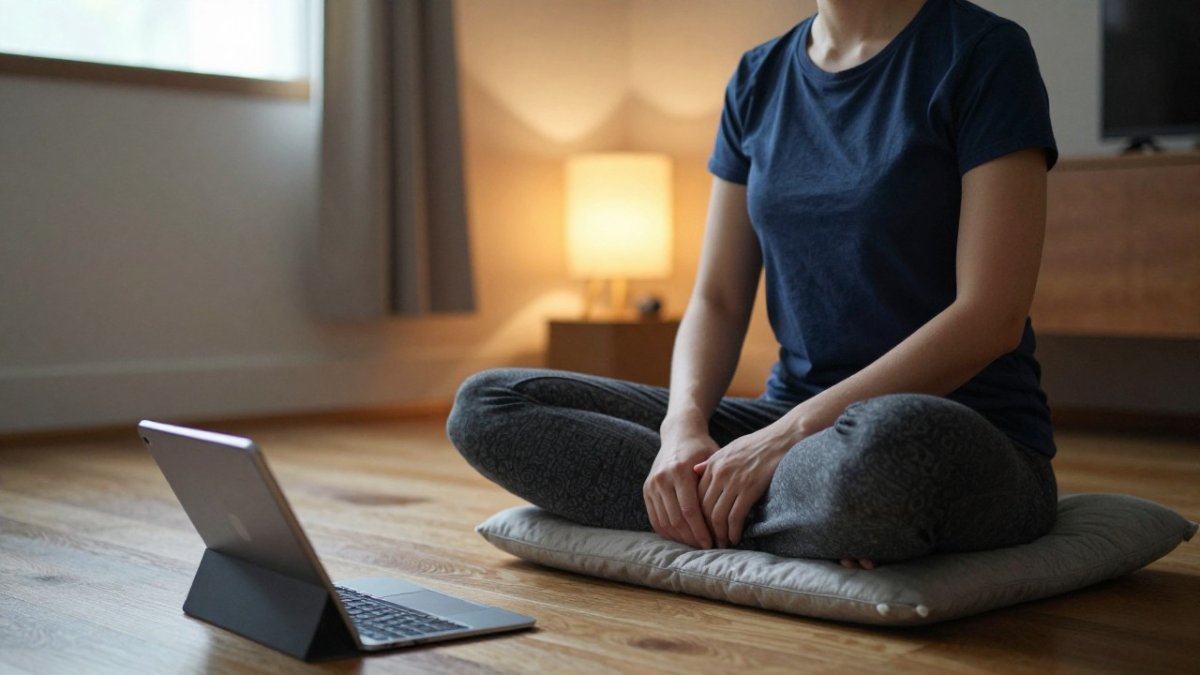
A nervous system meditation script is a spoken sequence that walks you through orienting, breathing, and body awareness in a fixed order.
- Orient (1 minute). Sit with feet flat. Slowly look around the room and name three things you see.
- Breathe low (2 minutes). Place a hand on your belly. Let the inhale expand your hand, and make the exhale slightly longer.
- Body check (3 minutes). Move attention from feet to head, noticing without fixing.
- Ground (2 minutes). Feel the chair, the floor, the weight of your body.
- Close (2 minutes). Return to breath, then open your eyes slowly.
For a broader set of beginner practices to run alongside this script, see our guide to nervous system regulation exercises for beginners.
Before You Press Play: Consent and Setup
Consent in this work means you decide what you do and when you stop. A trauma-informed facilitator will say this out loud at the start. Set up so you can pause easily: phone silenced, door closed, water nearby. Starting a body-focused practice in a rushed state can make the session feel jarring rather than settling, so give yourself a few minutes of quiet before you begin.
Somatic Exercises for Nervous System Regulation You Can Do at Home
Somatic exercises for nervous system regulation are simple body movements that help discharge stress and rebuild body awareness. They work because they use physical sensation, not thinking, to signal safety. Three we return to often:
- Orienting: slowly turn your head and let your eyes land on what is around you.
- Pendulation: gently shift attention between a tense area and a comfortable one.
- Grounding through contact: press your feet down and notice the push-back.
These are not stretches to perform perfectly. They are experiments in noticing. A common mistake is rushing through them to "finish." Slow down until you can feel a difference.
The 10 Minute Vagus Nerve Meditation: What It Is and When to Use It
A 10 minute vagus nerve meditation is a short practice that combines slow breathing, gentle humming or toning, and calm attention to engage the vagus nerve, a major pathway in the parasympathetic nervous system. It can suit moments when you want to downshift: before a difficult conversation, after a stressful call, or when you feel wired but tired. The humming matters more than it sounds. The vibration in the throat and chest is part of the practice. If humming feels uncomfortable, slow exhales alone are a reasonable substitute. For more specific techniques, our article on vagus nerve stimulation techniques for anxiety walks through them step by step.
What the Vagus Nerve Actually Does
The vagus nerve is the tenth cranial nerve, and it carries signals between the brain and organs including the heart, lungs, and gut. It is the main channel of the parasympathetic "rest and digest" branch, which is why slow breathing and humming are used to nudge the system toward calm. Some practitioners describe a longer exhale relative to the inhale as supporting calm over time, though any effect is gradual.
A Minute-by-Minute Sequence
Use this order the first several times so your body learns the path:
- Settle (1 minute). Sit upright, feet flat, and let your shoulders drop. No breath work yet.
- Low breath (3 minutes). Inhale through the nose for a count of four, exhale for a count of six. Keep the hand on the belly so you can feel the expansion.
- Hum (3 minutes). On each exhale, hum at a comfortable pitch until the breath runs out. Feel the buzz in the throat and chest.
- Slow exhale only (2 minutes). Drop the hum and keep the longer exhale. This is the fallback if humming felt odd.
- Close (1 minute). Return to normal breath and notice any shift in jaw, shoulders, or stomach.
Watch out: if the longer exhale makes you dizzy or air-hungry, shorten the counts to three in and four out, or stop the breath focus and return to feeling your feet.
When It Fits and When It Doesn't
This practice fits a wired-but-tired state, a pre-meeting reset, or the transition after a stressful call. It does not fit a fully shut-down or numb state, where gentle movement and orienting tend to land better, and it is a poor choice during acute panic if breath focus tends to intensify the feeling. In that case, use grounding through contact first and add the hum only once the system has settled a little.
A Trauma-Informed Body Scan Meditation: Adapting It to Your Body
A trauma-informed body scan meditation moves attention through the body slowly, with permission to skip areas and stop at any point. That permission is what separates it from a standard body scan. If attention on a particular region brings up distress, you are not failing; you are learning where your edges are. Try these adaptations:
- Keep your eyes open if closing them feels unsafe.
- Scan only from feet to knees, or hands to shoulders, and stop there.
- Anchor on an external object when a sensation gets intense.
If a practice brings up more than you can settle, grounding steps help. Our grounding for trauma recovery guide offers a step-by-step sequence you can use mid-session.
Choosing a Session Based on Your Current State
Match the practice to your state, not to a schedule. A short breathing track will not land well when you are agitated, and a long body scan can feel like too much when you are already raw. Use this as a starting point:
| Your current state | Best session type | Typical length | What to avoid |
|---|---|---|---|
| Agitated, racing thoughts | Slow breathing, orienting | 5-10 minutes | Long silent sits |
| Numb or disconnected | Gentle movement, pendulation | 10-15 minutes | Intense breathwork |
| Wired but tired | Vagus nerve toning | 10 minutes | Stimulating content |
| Overwhelmed, shut down | Grounding, short body scan | 5 minutes | Eyes-closed only |
| Steady and curious | Full body scan, visualization | 15-40 minutes | Rushing the close |
Typical length
How to Evaluate Online Sessions and Facilitators
Credentials matter. In this field, anyone can call themselves a coach, so ask directly what training and supervision a facilitator has. Look for trauma-informed language, clear consent statements, and a stated scope of practice. Our step-by-step guide to finding a qualified somatic coach safely gives you a fuller checklist for vetting facilitators before you commit.
Substance Abuse and Mental Health Services Administration guidance on trauma-informed care
A Practical Checklist Before You Book
Ask these questions directly, in writing if possible:
- Training and supervision. What certification or training did the facilitator complete, and do they receive ongoing supervision? A named modality and a supervisor are stronger signals than a vague "certified coach" badge.
- Scope of practice. Do they state what they do not treat? A facilitator who clearly separates coaching from therapy is safer than one who blurs the line.
- Consent and stopping. Is there an explicit statement that you can pause, modify, or leave at any time? This should appear before the first practice, not in fine print.
How to Compare Two Offerings Side by Side
Write the answers to the checklist for each option in the same order, then compare. A recorded course and a live one-to-one session each have different strengths; neither is automatically better. Match the format to your state: if you are easily overwhelmed, a small live session with a facilitator who checks in may suit you better than a large group, while a recorded track lets you pause without an audience.
Realistic Expectations and Evidence Quality
Distinguish established relaxation practices from stronger claims. Slow breathing, body awareness, and grounding are commonly used practices, but claims that a session permanently changes the nervous system go beyond what the evidence supports. Facilitators are often most transparent when they describe benefits in terms of stress management and skill-building rather than clinical outcomes, and refer you to a licensed professional when your needs exceed coaching.
Building a Practice That Fits Your Nervous System
Consistency beats intensity. A five-minute practice you actually do four times a week does more than a 40-minute session you dread. If you want a clearer sense of timeline, read about how long nervous system regulation takes to work.
Stress and disconnection rarely resolve by thinking harder about them. They shift through the body, slowly and with support. The BodyVox offers somatic, body-based coaching built around consent, including private 1:1 immersions and global retreats.
Frequently Asked Questions
What happens in a guided nervous system regulation session online?
Most sessions guide you through breath awareness, a body scan, and grounding or somatic exercises, either live or as a recorded audio. A facilitator narrates cues while you track sensations in your body. The goal is nervous system regulation, meaning you learn to move between states of activation and calm on purpose. Sessions usually run from five minutes to about 40 minutes, and trauma-informed facilitators build in choices so you can pause, open your eyes, or skip any instruction.
Can guided meditation help calm the nervous system?
Guided meditation is one of the more accessible ways to practice nervous system regulation. Some people find that slow breathing and body awareness help them move toward a calmer state. Effects vary by person and by how consistent the practice is. Many people notice a short-term calming effect after a single session, while broader changes in stress and emotional regulation usually come from practicing regularly over weeks.
How long should a nervous system regulation session last?
Start with five to 10 minutes if you are new or easily overwhelmed. A 10 minute vagus nerve meditation is a practical daily length, while 15- to 40-minute sessions suit people who want a deeper body scan or visualization practice. Shorter sessions are easier to repeat, and repetition matters more than length. If a longer session leaves you agitated, drop back to five minutes and build up gradually.
What should I do if a guided meditation makes me feel overwhelmed?
Open your eyes, look around the room, and press your feet into the floor. Name a few objects you can see and hear to reorient. You can stop the audio at any point; you are in charge of the session. If strong feelings or memories come up, a trauma-informed facilitator or therapist can help you process them safely. Online sessions are a support, not a substitute for professional mental health care.