 blog
blog
7 Nervous System Regulation Exercises for Beginners
Table of Contents
- Understanding Nervous System Regulation and Why It Matters
- Breathing Exercises for Nervous System Regulation
- Somatic Exercises for Anxiety and Body Awareness
- Vagus Nerve Exercises for Beginners
- Grounding Exercises for Trauma and Emotional Regulation
- How to Choose the Right Exercise for Your Current State
- Safety Guidance, Modifications, and When to Seek Professional Support
- Building a Sustainable Practice: Frequency, Duration, and Progress
- Frequently Asked Questions
Last Updated: October 8, 2026
Understanding Nervous System Regulation and Why It Matters
Your nervous system controls your heartbeat, breathing, digestion, and stress response. When it gets stuck in a stress response, you feel anxious, disconnected, or numb.
Nervous system regulation is the ability to move your body from a stressed state to a calm one using simple techniques that signal safety to your brain and body.
At The BodyVox, we work with clients who feel disconnected from their bodies, many after years of talk therapy without real physical change. Somatic practices teach your body directly through movement, breath, and sensation.
These techniques work for beginners with no experience or equipment, and most take just 5 to 10 minutes.
Breathing Exercises for Nervous System Regulation
Breathing is the fastest way to shift your nervous system. Unlike your heartbeat, you can control your breath, and your nervous system responds to those changes.
Slow breathing tells your body you're safe; fast, shallow breathing signals danger. By slowing your exhale, you activate the parasympathetic nervous system, which helps you rest and recover.
Box Breathing: A Foundational Technique
Box breathing is simple and works fast: breathe in for a count, hold, breathe out for a count, and hold again. The equal counts create a rhythm that calms your nervous system.
Here's how to do it:
- Sit or lie down in a comfortable position
- Breathe in through your nose for a count of 4
- Hold your breath for a count of 4
- Exhale through your mouth for a count of 4
- Hold empty for a count of 4
- Repeat 5 to 10 times
Start with a count of 4, drop to 3 if that feels too long, or try 5 or 6 for more intensity. The point is balance: in-breath, hold, out-breath, and hold should all be the same length.
Do this when you feel anxious, before bed, or during the day when stress builds.
Extended Exhale Breathing
This technique is simpler than box breathing: make your exhale longer than your inhale. A longer exhale signals your body to relax more deeply.
Here's the practice:
- Sit comfortably with your spine upright
- Breathe in through your nose for a count of 4
- Exhale through your mouth for a count of 6 or 8
- Repeat 8 to 10 times
The longer exhale is key: it activates your parasympathetic nervous system more than your inhale does. A 4-count in and 6-count out works well for most people.
Use this when your shoulders creep toward your ears or your chest feels tight. Extended exhale breathing is one of the fastest ways to signal calm to your body.
Somatic Exercises for Anxiety and Body Awareness
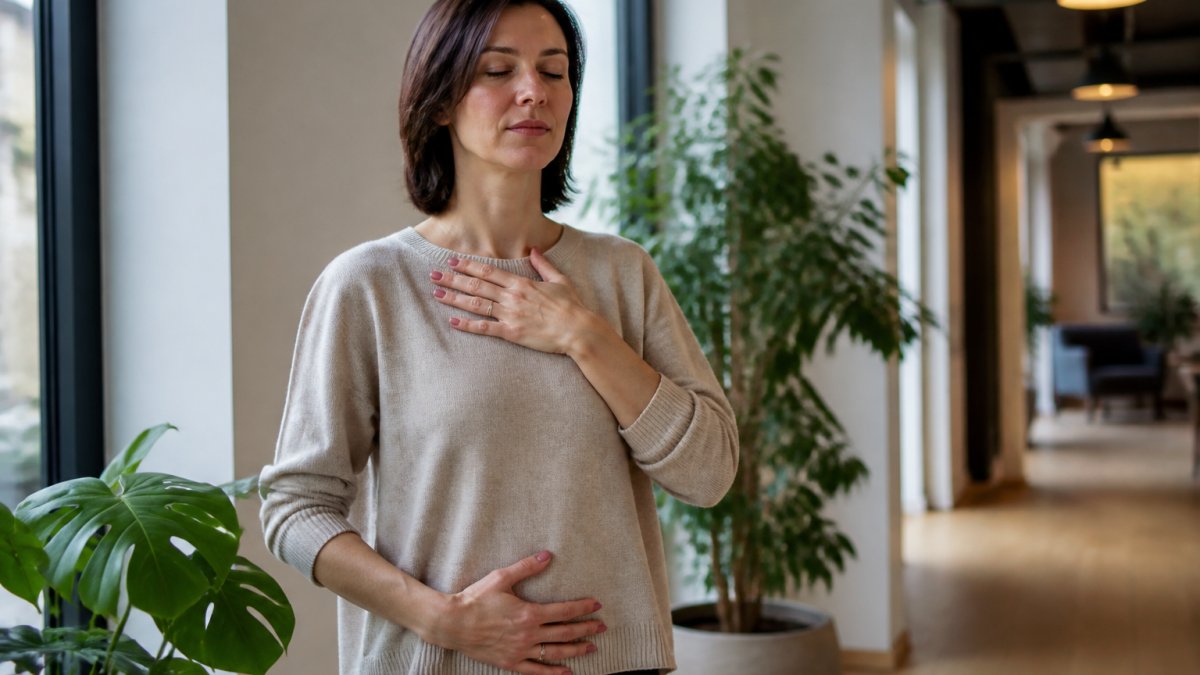
Somatic exercises teach your body to notice itself. They bring awareness to physical sensations. When you've been numb or disconnected, this awareness is the first step back.
Anxiety lives in your body as tension, a tight chest, or a clenched jaw. Somatic exercises help you locate and release that tension. You're not thinking your way out of anxiety, you're moving your way out.
Progressive Muscle Relaxation
Progressive muscle relaxation teaches you the difference between tension and relaxation: tense a muscle group, hold it, then release, so your body learns what true relaxation feels like.
This is the practice:
- Lie on your back or sit in a chair with support
- Start with your feet. Squeeze the muscles as hard as you can for 5 seconds
- Release and notice the feeling of relaxation for 10 seconds
- Move up to your calves and repeat
- Continue up through your thighs, glutes, belly, chest, arms, hands, shoulders, neck, and face
- Spend 5 to 10 seconds tensing each area and 10 seconds relaxing
The whole practice takes about 15 minutes. Do it daily or whenever you notice you're holding tension.
Your nervous system learns the contrast: tension followed by release teaches your body what safe feels like. Over time, you notice tension before it builds up.
Body Scan for Present-Moment Awareness
A body scan brings your attention to each part of your body without trying to change anything. This grounds you in the present moment and away from anxious thoughts.
Here's how:
- Lie down or sit comfortably with your eyes closed
- Start at the top of your head. Notice any sensations. Heat, coolness, tingling, or numbness
- Move your attention slowly down: forehead, eyes, nose, mouth, jaw, neck, shoulders
- Continue down your arms, hands, chest, belly, back, hips, legs, and feet
- Spend 10 to 15 seconds on each area
- Don't try to feel anything specific. Just notice what's there
The whole practice takes 10 to 15 minutes. When your mind wanders, just bring your attention back to the body part you're scanning.
Body scans interrupt the anxiety loop: instead of spinning in your thoughts, you're anchored in physical sensation. This is what grounding means.
Vagus Nerve Exercises for Beginners
The vagus nerve runs from your brain down through your body and controls your parasympathetic nervous system. Stimulating it activates your body's relaxation response.
You don't need to understand the anatomy, just know that certain simple actions activate this nerve and calm your nervous system.
Humming and Vocal Toning
Humming stimulates your vagus nerve through vibration and is one of the easiest techniques.
Here's the practice:
- Sit or lie down comfortably
- Take a deep breath in through your nose
- Exhale while humming. Make a low, steady hum sound
- Keep the hum going for the entire exhale
- Repeat 5 to 10 times
You can also try vocal toning with an "OM" or any vowel sound that feels good. The vibration in your chest and throat travels along the vagus nerve and signals calm to your body.
Do this when you feel stuck or numb, the vibration helps you feel more alive in your body. Many people hum before trying more active exercises.
Cold Water Exposure
Cold water activates your vagus nerve quickly, and you don't need a frozen lake, a simple cold water practice works.
Here's how:
- Fill a bowl with cold water. Ice water is ideal
- Splash the cold water on your face, or dunk your face for 5 to 10 seconds
- Breathe slowly and notice what happens in your body
- Start with just 5 seconds if cold feels intense
Your body will respond reflexively to cold, heart rate and breathing may shift as your vagus nerve activates. Over time, cold exposure teaches your nervous system that it can handle stress and recover.
Start small: even splashing your face counts, and you can also run cold water on your wrists or neck.
Grounding Exercises for Trauma and Emotional Regulation
Grounding brings you back to the present moment. When trauma or big emotions take over, grounding exercises anchor you back into your body.
These exercises use your senses, what you see, hear, feel, taste, and smell, to interrupt the trauma response and bring you back to now.
The 5-4-3-2-1 Sensory Grounding Technique
This is one of the most reliable grounding exercises: five things you see, four you can touch, three you hear, two you smell, and one you taste.
Here's the practice:
- Name 5 things you can see. Look around. Notice colors, shapes, textures
- Name 4 things you can touch. Feel the texture of your clothes, the chair, the ground
- Name 3 things you can hear. Listen for sounds near and far
- Name 2 things you can smell. If you can't smell anything, that's okay. Just notice
- Name 1 thing you can taste. This might be the taste in your mouth or a food you eat
The whole practice takes 2 to 5 minutes. In emotional overwhelm or a trauma response, it brings you back to your senses and the present moment, your nervous system can't be in past trauma and present sensation at the same time.
Gentle Movement and Stretching
Movement tells your nervous system you're safe and capable. Gentle stretching releases physical tension where trauma gets stored.
A simple practice:
- Stand with your feet shoulder-width apart
- Slowly roll your shoulders backward 5 times
- Tilt your head gently to each side, holding for 10 seconds
- Reach your arms overhead and gently arch your back
- Fold forward and let your arms hang
- Sway gently side to side
- Take 5 slow breaths
This takes about 3 to 5 minutes. You're not stretching hard or achieving a pose, you're moving slowly and noticing how your body feels, teaching your nervous system that movement is safe.
Gentle stretching helps after long periods of sitting and works well before bed to release the day's tension.
How to Choose the Right Exercise for Your Current State
Different exercises work for different nervous system states. If you're panicked, box breathing works faster than a body scan.
Here's how to choose:
If you feel panicked or racing: Use box breathing or extended exhale breathing. These work in minutes and slow your system down fast.
If you feel stuck or numb: Use humming, cold water, or gentle movement.
If you feel anxious but not in crisis: Use progressive muscle relaxation or a body scan.
If you feel disconnected from your body: Use the 5-4-3-2-1 grounding technique or body scan.
If you have time and want a full practice: Combine techniques.
Pay attention to how your body responds, what works one day might not work the next.
Safety Guidance, Modifications, and When to Seek Professional Support
If you have a respiratory condition, talk to your doctor before doing breathing exercises.
If you have a history of trauma, start slowly. Grounding exercises can bring up big emotions, which is normal.
If cold water feels too intense, start with room temperature water. You can gradually go colder as your nervous system adapts.
If you feel dizzy or lightheaded, stop the exercise. You might be breathing too fast or too deeply.
When to seek professional support:
These exercises are tools, not a replacement for therapy or medical care.
Building a Sustainable Practice: Frequency, Duration, and Progress
The best nervous system regulation exercise is the one you actually do. Consistency matters more than intensity.
Start small. Pick one exercise and do it 5 minutes a day for a week. Notice whether it helps and feels good.
Track what works. Keep a simple log of which exercises help most, when you use them, and how you feel after.
Progress looks like:
- Noticing tension earlier before it builds
- Recovering from stress faster
- Feeling more present in your body
- Sleeping better at night
- Having more emotional stability
Everyone is different.
Learning to regulate your nervous system is one of the most important things you can do for your wellbeing.
Frequently Asked Questions
How often should I practice nervous system regulation exercises to see results?
Start with 5-10 minutes daily or 3-4 times per week. Consistency matters more than duration. Many people notice improved calm and body awareness within 1-2 weeks of regular practice. If you're managing anxiety or trauma, daily practice during stressful periods can help regulate your nervous system more effectively. Listen to your body and adjust frequency based on what feels sustainable for you.
What's the difference between somatic exercises for anxiety and traditional breathing techniques?
Somatic exercises for anxiety focus on body awareness and sensation alongside breath, helping you release physical tension and reconnect with your body. Traditional breathing techniques target the nervous system through breath patterns alone. Somatic work is particularly helpful if you feel disconnected from your body or carry tension from trauma, as it engages your whole system rather than just your lungs and mind.
Can vagus nerve exercises for beginners really help with anxiety and stress?
Yes. The vagus nerve connects your brain to your body and plays a key role in activating your parasympathetic nervous system, which calms your stress response. Exercises like humming, cold water exposure, and gentle stretching stimulate this nerve and signal safety to your nervous system. Results vary by person, but many people experience reduced anxiety and improved emotional regulation with consistent practice.
Are grounding exercises for trauma safe to do on my own, or do I need professional guidance?
Basic grounding exercises like the 5-4-3-2-1 technique are safe for most people to practice independently. However, if you're processing significant trauma or experiencing dissociation, working with a trauma-informed therapist or somatic coach can help you practice safely and adapt exercises to your nervous system's needs. A professional can also help you understand your specific triggers and design a practice tailored to your healing journey.