 How-to
How Intimacy Retreats Help Long-Term Couples Reconnect
Last Updated: November 22, 2026
Quick Summary
Intimacy retreats are guided, multi-day programs where long-term couples step away from daily routines to rebuild emotional and physical connection with professional support. Facilitators guide structured conversations and body-based exercises, but the lasting change comes from the skills couples practice and carry home.
- The drift into a roommate dynamic rarely happens overnight; careers, children, and stress bury desire.
- A typical retreat day mixes guided workshops, private couple time, and shared meals.
- Clinical intensives are led by licensed mental health professionals and resemble therapy more than a relaxation weekend.
- Ask facilitators directly about credentials, consent practices, and trauma-informed care before booking.
- Schedule a weekly check-in and keep one or two guided exercises in rotation after you return home.
Table of Contents
- Why Long-Term Couples Lose Intimacy and What a Retreat Changes
- What Happens at a Couples Retreat: A Realistic Walkthrough
- Couples Intimacy Workshops vs. Full Retreats: Which Fits You
- Choosing a Couples Retreat to Rebuild Intimacy Without Guesswork
- How Long Are Couples Retreats and What Should You Budget
- Preparing Together and Sustaining Progress After You Return Home
- Booking a Consultation to See If a Somatic Retreat Fits Your Relationship
- Frequently Asked Questions
Why Long-Term Couples Lose Intimacy and What a Retreat Changes
Intimacy retreats for long-term couples are guided, multi-day programs where partners step away from daily routines to rebuild emotional and physical connection with professional support. At The BodyVox, we see the same pattern repeatedly: couples who love each other deeply but have drifted into what many describe as a roommate dynamic.
The drift rarely happens overnight. Careers expand. Children arrive. Stress accumulates in the body, and touch becomes transactional or disappears entirely. Many couples find that conversation narrows to logistics: schedules, bills, household tasks. Desire doesn't vanish so much as it gets buried under fatigue and unspoken resentment.
A retreat changes the environment first. Removing work emails, chores, and familiar arguments creates space for a different kind of attention. Facilitators then guide couples through structured conversations and body-based exercises that surface what routine has hidden.
What most guides miss is this: the retreat itself is not the fix. It is a container where new relationship skills get practiced under guidance. The lasting change comes from what couples carry home.
What Happens at a Couples Retreat: A Realistic Walkthrough
Most retreats follow a rhythm of guided sessions, private couple time, and shared meals. A typical day might begin with a morning check-in, move into a facilitated workshop, break for private reflection, and end with unstructured time together.
Guided Exercises, Private Time, and Group Sessions
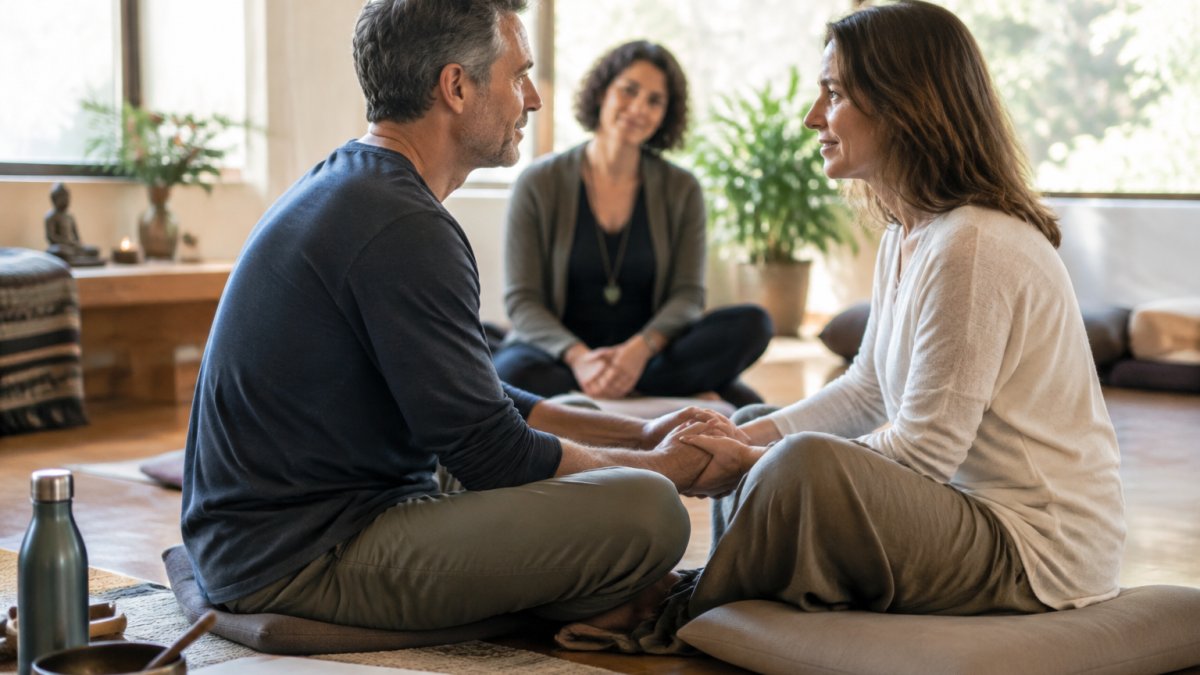
Guided exercises form the core of most programs. These may include structured communication prompts, breathwork, eye contact practice, and gentle touch exercises designed to rebuild comfort with closeness. A somatic, body-based approach focuses on what partners feel in their bodies rather than only what they say.
Private time matters as much as the group work. Couples need room to process without an audience. Many retreats build in afternoons for rest, walks, or simply being together without an agenda.
Group sessions vary widely. Some retreats are entirely private for one couple. Others place several couples in a small-group format, which can reduce isolation and normalize shared struggles. If you want a detailed picture of how these days unfold, our guide on what to expect from intimacy retreats walks through the structure hour by hour.
Couples Intimacy Workshops vs. Full Retreats: Which Fits You
A workshop is a short, focused session, often a single day or a few hours. A full retreat spans multiple days and usually includes accommodation, meals, and a deeper arc of guided work.
| Format | Typical Duration | Best For | Main Trade-off |
|---|---|---|---|
| Single workshop | A few hours to one day | Couples testing the waters or learning one skill | Limited time to practice and integrate |
| Weekend retreat | Two to three days | Couples wanting a reset without long time away | Progress can fade without follow-up |
| Multi-day retreat | Four to seven days | Deep work on patterns, desire, and communication | Higher cost and more time commitment |
| Private couples intensive | Custom, often two to five days | Couples who want full privacy and tailored pacing | Fewer group learning opportunities |
Couples intimacy workshops suit partners who are curious but hesitant. Full retreats suit couples ready to invest sustained attention. Neither format replaces ongoing practice at home.
Choosing a Couples Retreat to Rebuild Intimacy Without Guesswork
Most couples arrive at this decision with a vague goal, "we want to feel close again", and a search results page full of programs that all promise the same thing.
Clinical intensives are led by licensed mental health professionals and are structured more like therapy than like a relaxation weekend.
Coaching retreats are led by certified coaches rather than licensed clinicians. They tend to focus on skills, communication structure, and forward-looking goal setting.
Experiential workshops are the broadest category: somatic and body-based programs, tantra and touch workshops, communication intensives, and nature-based retreats. They suit couples who want to learn by doing and are comfortable with group formats.
A practical comparison looks like this:
| Program type | Typical lead facilitator | Best fit | What to verify |
|---|---|---|---|
| Clinical intensive | Licensed therapist or psychologist | Identifiable relational pattern, trauma history, crisis recovery | License number and state, clinical supervision, referral network |
| Coaching retreat | Certified coach | Stable but stuck, skills and goal setting | Certification body, hours of supervised practice, scope-of-practice limits |
| Experiential workshop | Varies widely | Learning by doing, group learning, somatic work | Consent protocol, group size, facilitator training in touch-based work |
Start with the outcome you want. A couples retreat to rebuild intimacy should name its approach clearly: Is it talk-based therapy, somatic work, coaching, or a mix? Vague marketing language is a warning sign.
Ask directly about the facilitator's training. In this field, credentials vary widely, and anyone can call themselves a coach. Legitimate practitioners typically hold certifications from recognized bodies and can explain their supervision and continuing education.
Credentials, Consent Practices, and Trauma-Informed Care
Trauma-informed care is not a buzzword. It means the facilitator understands how past experiences shape present reactions and builds in choices at every step. Consent-focused practice means you are asked before any exercise, and you can decline without penalty. In body-based work especially, ask how touch is introduced, whether touch between partners is ever directed by the facilitator, and how a couple can opt out without disrupting the group.
Our recommendation: treat these as non-negotiable screening questions, not nice-to-haves.
- What is your training and certification, and who issued it?
- How do you handle consent during exercises, including touch-based ones?
- What is your approach when one partner becomes overwhelmed or dissociates?
- Do you offer referrals to licensed therapists when needed, and do you have a written referral list?
- What is your group size, and how do you handle confidentiality in group formats?
- Can we speak with former participants or read independent reviews?
The American Association of Sexuality Educators, Counselors and Therapists maintains a directory of certified professionals, which is a useful starting point for verifying credentials. For anyone processing trauma, the National Center for PTSD also offers background on how trauma affects closeness and what safe support looks like.
A facilitator who cannot describe a clear referral path to licensed clinical care may not be well suited to couples where trauma, addiction, or abuse is present. A retreat is the wrong setting for active abuse or untreated addiction; individual clinical care comes first.
How Long Are Couples Retreats and What Should You Budget
Couples retreats can run from a single day to about a week. Duration and format are worth comparing with each provider when you are deciding what fits your relationship.
Budget depends on format, location, group size, and whether accommodation and meals are included. Rather than quote a single number, it helps to understand the cost structure. Pricing depends on quantity, dates, format, and what each program includes, so The BodyVox's current prices are best confirmed on its website or through a quote.
The biggest price drivers are:
- Facilitator credentials. Facilitator credentials and experience can affect what a program costs.
- Private versus group. A private immersion for one couple costs more per couple than a shared group program, because the facilitator's time is not divided.
- Lodging and meals. All-inclusive pricing is convenient but can obscure the true program cost; compare the program fee separately from room and board.
- Location and season. Destination settings and peak dates carry premiums.
- Follow-up. Some programs include post-retreat sessions; others charge separately.
Factor in travel, time off work, and any follow-up sessions. For couples with caregiving responsibilities, the real constraint is often time away rather than the program fee, a weekend format with a Friday evening start can reduce the number of workdays missed.
Watch out: a low headline price can hide extra charges for private sessions, materials, or mandatory add-ons. Get the total in writing before you commit, and confirm the cancellation and refund policy in the same document.
Preparing Together and Sustaining Progress After You Return Home
Preparation starts with an honest conversation. Share what you hope to change and what makes you nervous. The goal is alignment, not agreement on everything.
Our article on how to discuss intimacy retreats with your partner offers language for raising the topic without triggering defensiveness. If one partner is reluctant, slow down and explore the resistance rather than pushing.
The weeks after the retreat matter most. Old routines reassert quickly. We suggest scheduling a weekly check-in, keeping one or two of the guided exercises in rotation, and planning a follow-up session. Simple practices, like a daily few minutes of undistracted contact, help new habits take root. A list of activities that strengthen emotional safety can keep the work alive once the retreat glow fades.
Booking a Consultation to See If a Somatic Retreat Fits Your Relationship
Not every couple needs a retreat. If there is active abuse, untreated addiction, or a crisis, a retreat is not the right setting; seek individual clinical care first. For couples in a stable but stuck place, a consultation is the lowest-risk way to find out whether this work fits.
Understanding the benefits of somatic therapy for intimacy can help you decide whether a body-based approach matches what you are looking for. At The BodyVox, our approach is trauma-informed and client-led. We offer Private 1:1 Immersions for Individuals and Couples and Sensuality Retreats for Gay Bisexual Trans and Queer Men.
A consultation is a conversation, not a commitment. Bring your questions, your hesitations, and your hopes.
If your relationship feels more like a partnership of logistics than intimacy, you are not alone, and the pattern is workable. The BodyVox offers somatic sex and intimacy coaching, couples coaching, and private immersions designed to help partners move beyond performance toward embodied connection. Our client-led approach is designed to respect your pace and boundaries.
Frequently Asked Questions
Can intimacy retreats actually help long-term couples reconnect?
They can help when the format matches the problem. A retreat removes the daily routines that keep couples in a roommate pattern and gives them structured, facilitated time to practice new ways of talking and touching. The couples who benefit most arrive with a shared willingness to try, not one partner dragging the other. Retreats are not a cure for deep relational damage, and lasting change depends on what you both do in the weeks after you return home.
How long are couples retreats, and how much do they cost?
Most run two to seven days, with weekend formats being the most common entry point and multi-day intensives offering deeper work. Pricing varies widely by duration, location, group size, and whether sessions are private or small-group, so ask each provider directly for a quote rather than relying on posted averages. Factor in travel and lodging if the retreat is residential. Compare total cost against the number of facilitated hours you actually receive.
What should couples expect from a sex-positive retreat?
Expect explicit ground rules around consent, boundaries, and privacy, and expect that you can decline any exercise without penalty. A well-run sex-positive retreat teaches communication and embodied awareness rather than pushing anyone into activity. Ask in advance whether exercises are done privately as a couple, in pairs within a group, or individually, and confirm the facilitator's training and supervision. If a provider cannot explain its consent policy clearly, keep looking.
How do we choose the right intimacy retreat for us?
Start with your actual goal: communication, desire, physical connection, or recovery from disconnection. Then screen providers on credentials, trauma-informed training, group size, and whether the format is private or group-based. Ask for a short call before booking so you can describe your situation and hear how the facilitator works. Couples who feel rushed or dismissed on that call should treat it as a signal. A retreat should feel like a considered choice, not a purchase.